A resort is not a hotel. It is a destination. Unlike a city hotel, which prioritizes efficiency and maximizing rooms per square meter, a resort prioritizes experience: the view, the pool, the beach, the restaurant, the spa, the connection to landscape. A resort plan must balance guest rooms (privacy, views, quiet) with public facilities (restaurants, bars, pools, spa, meeting rooms) and service areas (kitchens, laundry, staff housing, maintenance). The plan must work in three dimensions (buildings are often low-rise, spread out) and in two modes (peak season high occupancy, off-season low occupancy).
These 5 resort design plans span beachfront, hillside, eco-lodge, all-inclusive, and wellness configurations. Each includes defining characteristics, dimensional guidelines, and a prompt for visualization.
1. The Beachfront Resort (Linear, Ocean-Facing)
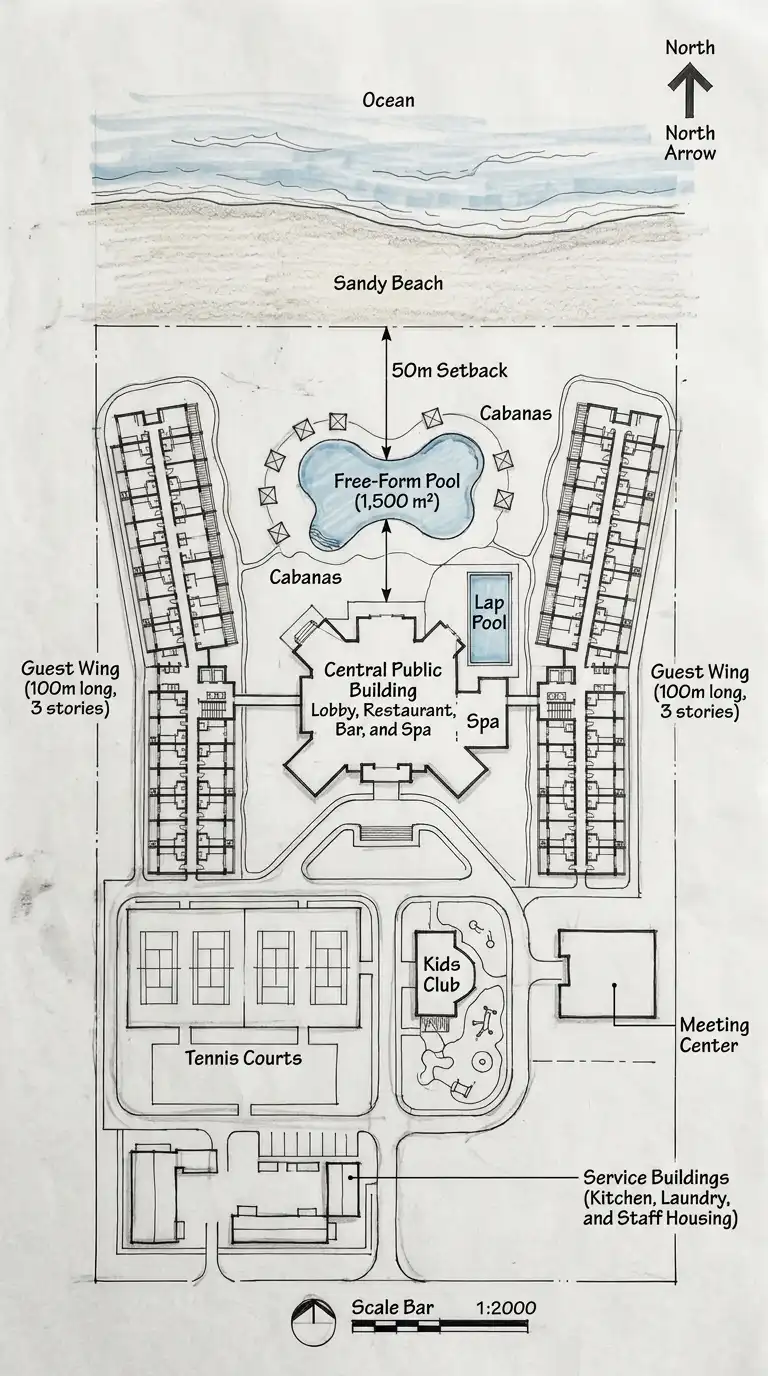
A resort organized along a linear beachfront. Guest rooms are in low-rise buildings (2-4 stories) facing the ocean. The main public building (lobby, restaurant, bar, spa) is at the center. Pools, cabanas, and sun decks are between the guest buildings and the beach. Service areas (kitchens, laundry, staff) are at the rear (land side). The plan is linear: the beach is the primary orientation; all rooms face it. This is the classic beach resort plan.
This plan is for oceanfront sites, beach destinations, or any site with a linear natural feature (river, lake). The emotional effect is linear, ocean-facing, and relaxed.
Quick Specs
- Site depth: 150-300m (beach to road).
- Guest room wings: 50-150m long, 2-4 stories.
- Guest room count: 100-500 rooms.
- Room size: 30-50 m² (standard) to 80-150 m² (suites).
- Pool: 500-2000 m² (multiple pools).
- Building setback from beach: 30-60m (regulated).
2. The Hillside Resort (Stepped, View-Oriented)
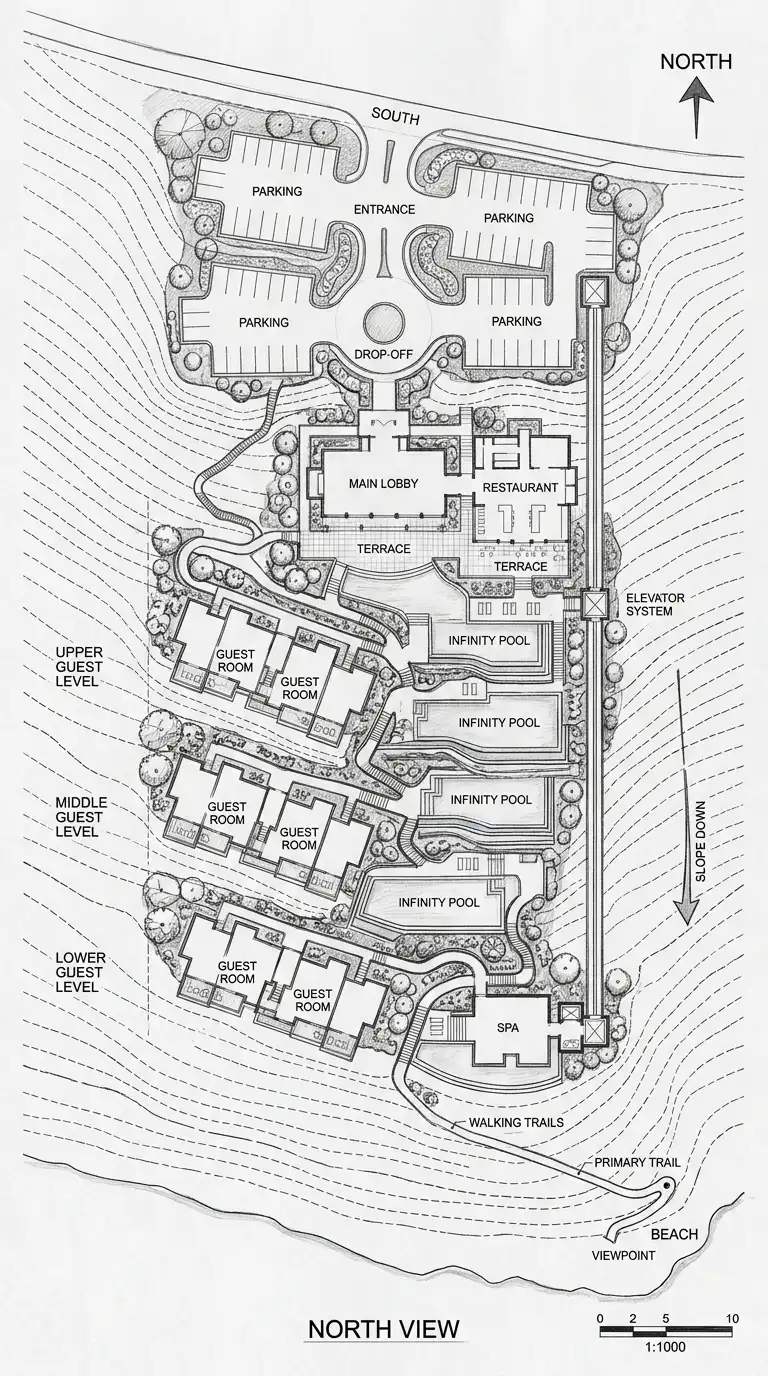
A resort on a sloping site (hillside, mountainside, coastal bluff). Guest rooms and public buildings are stepped down the slope, each level with a view. The entrance and parking are at the top (uphill). The lobby, restaurants, and pools are at middle levels. Guest rooms are at lower levels, each with a balcony or terrace facing the view. The lowest level (downhill) may have a beach, marina, or trailhead. The plan minimizes earthmoving (buildings step with the slope) and maximizes views.
This plan is for hillside sites, mountain resorts, or any site with a significant view. The emotional effect is stepped, view-oriented, and terraced.
Quick Specs
- Slope: 15-40%.
- Levels: 3-8 (stepped with the slope).
- Guest room count: 50-200 rooms (spread out).
- Room size: 35-60 m² with balcony.
- Elevators: required (or funicular for steep sites).
- Parking: at the top (uphill).
3. The Eco-Lodge Resort (Low-Impact, Dispersed, Nature-Integrated)
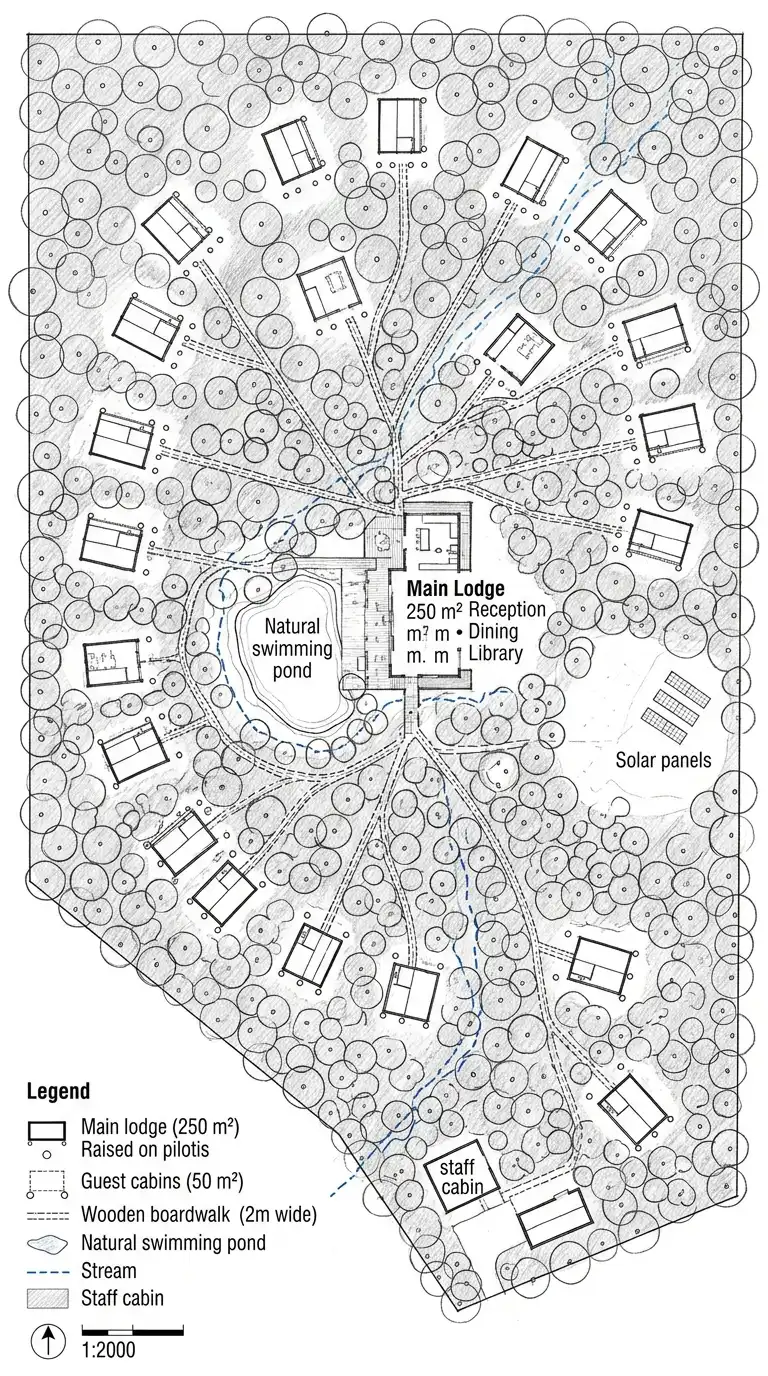
A resort designed for minimal environmental impact. Buildings are small, dispersed, and raised on pilotis (to avoid disturbing the ground). Guest cabins are separate pavilions hidden in the forest. The main lodge is small. Paths are boardwalks (not paved). Energy is solar. Water is from a well or rainwater. Waste is treated on-site. The resort has no large pool (or a natural swimming pond). The plan is decentralized, low-density, and nature-first.
This plan is for rainforest sites, island sites, or any sensitive ecosystem where environmental impact must be minimized. The emotional effect is dispersed, low-impact, and nature-integrated.
Quick Specs
- Site size: 10-100 hectares (25-250 acres).
- Guest cabin count: 10-50 cabins.
- Cabin size: 40-80 m² each (raised on pilotis).
- Cabin spacing: 20-50m apart (privacy).
- Paths: wooden boardwalks (2-3m wide).
- Main lodge: 200-500 m².
- No large pool (or natural pond).
4. The All-Inclusive Resort (High Density, Centralized, Multiple Pools)
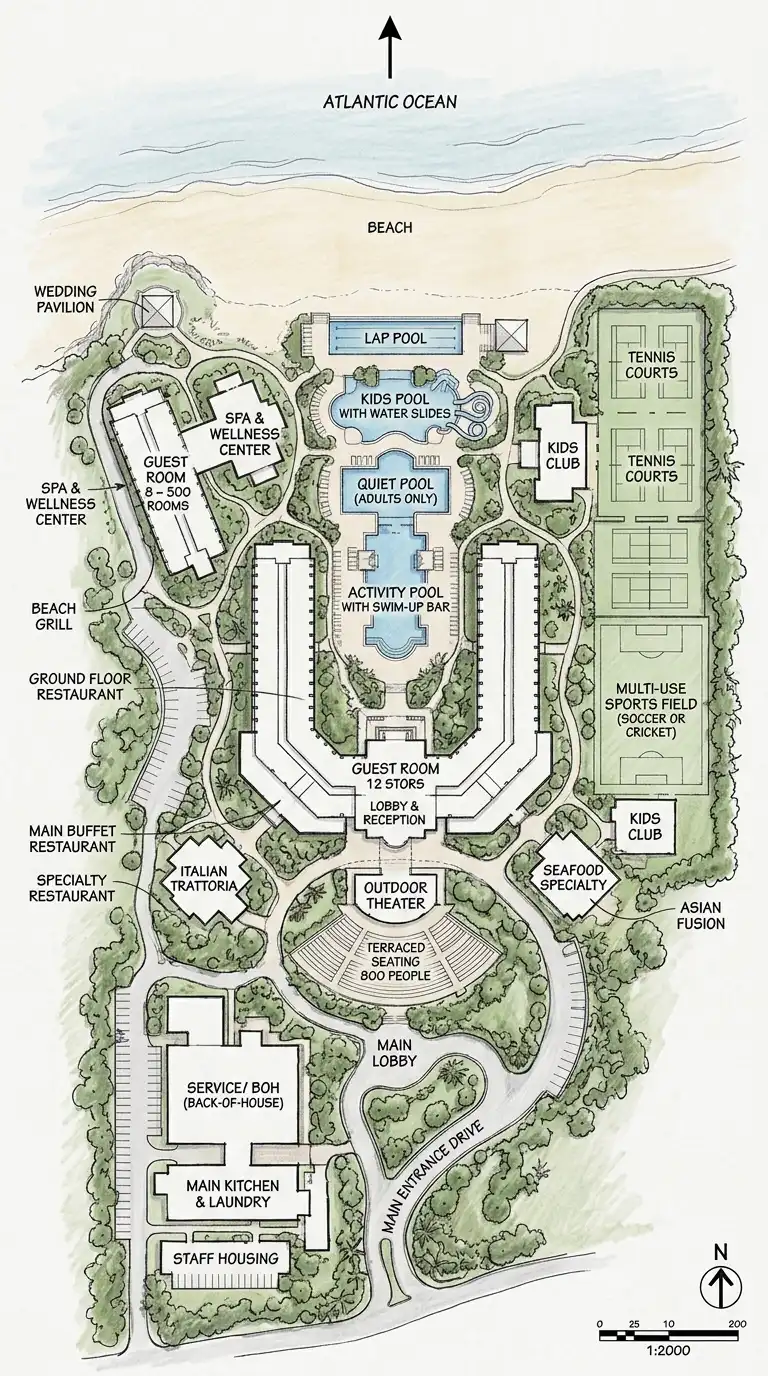
A resort designed for high guest density (400-2000 rooms). The plan is centralized: one or two large guest room buildings (6-12 stories) containing most rooms. All public facilities (multiple restaurants, bars, pools, theater, nightclub, kids club, sports courts) are at the ground level or in separate low-rise buildings. The plan maximizes efficiency (short walks, easy service) and minimizes land use. This is the plan of large Caribbean and Mexican resorts.
This plan is for large sites near airports, or any destination where guests want convenience and variety without leaving the property. The emotional effect is centralized, high-energy, and amenity-rich.
Quick Specs
- Site size: 10-50 hectares.
- Guest room count: 400-2000 rooms.
- Guest room building: 6-12 stories, 200-400 rooms per building.
- Room size: 30-40 m² (standard).
- Pools: 3-8 pools (activity pool, quiet pool, kids pool, lap pool).
- Restaurants: 5-15 (buffet, à la carte, specialty).
- Theater: 500-1500 seats.
5. The Wellness Resort (Spa-Centric, Low Density, Healing Focus)
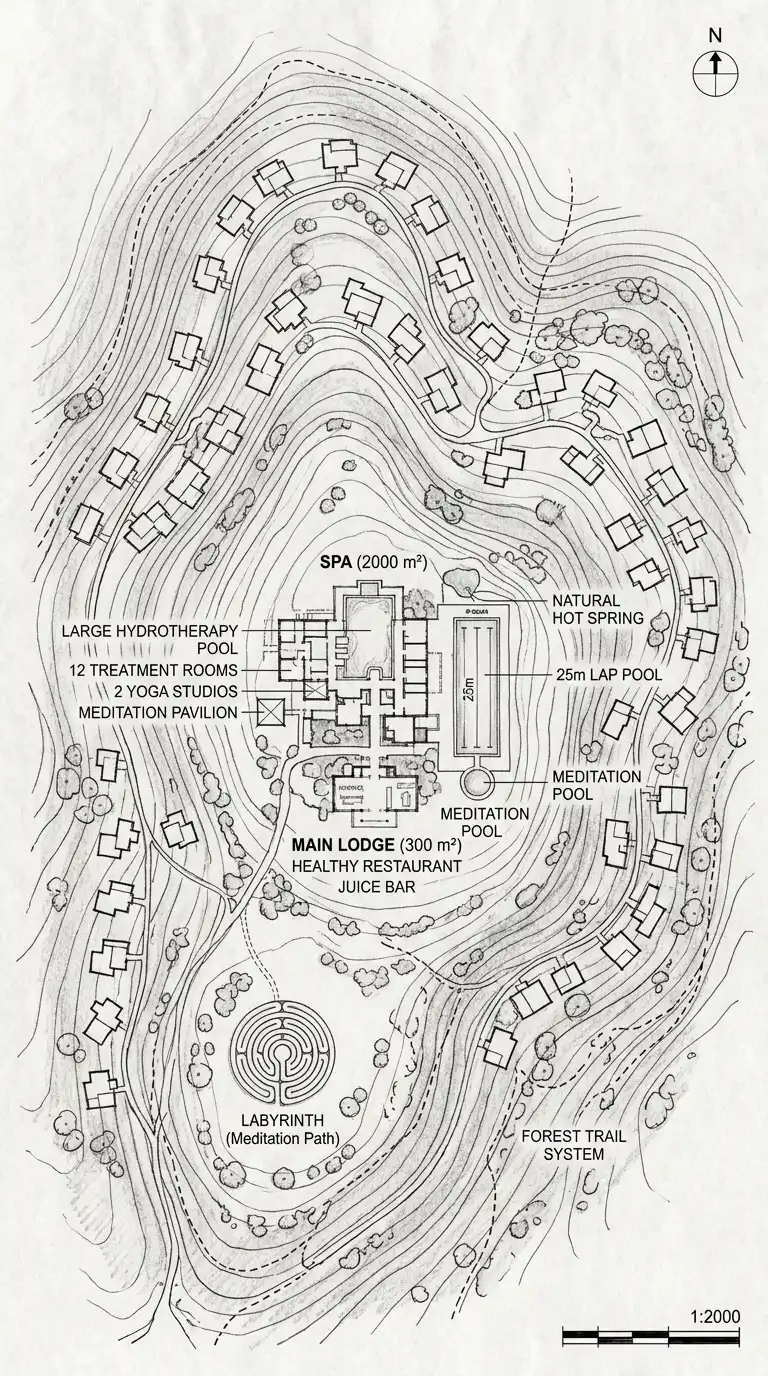
A resort focused on health, wellness, and healing. Guest rooms are low-density (villas or small buildings). The spa is the center of the resort—larger than the lobby, larger than the restaurant. Facilities include treatment rooms, yoga studios, meditation pavilions, hydrotherapy pools, and a fitness center. Food is healthy (organic, plant-based). The resort is quiet (no loud music, no swim-up bars, no theater). The plan is peaceful, natural, and restorative.
This plan is for clients seeking a wellness-focused experience, or for sites with natural healing resources (hot springs, mineral water, clean air). The emotional effect is spa-centric, quiet, and restorative.
Quick Specs
- Guest room count: 30-150 rooms (villas or small buildings).
- Villa size: 50-120 m² each (with private garden or terrace).
- Spa size: 1000-5000 m² (treatment rooms, hydrotherapy, yoga).
- Pools: hydrotherapy pool, lap pool, meditation pool (no activity pool).
- Restaurants: 1-3 (healthy, organic).
- No theater, no nightclub, no swim-up bar.
Comparison Summary
| Resort Type | Primary Feature | Guest Rooms | Density | Pools | Site |
|---|---|---|---|---|---|
| Beachfront | Linear, ocean-facing | 100-500 rooms, low-rise | Medium | 1-3 (large) | Beachfront, flat |
| Hillside | Stepped, view-oriented | 50-200 rooms, stepped | Low | 1-3 (terraced) | Sloping, view site |
| Eco-Lodge | Low-impact, dispersed | 10-50 cabins, separate | Very low | None or natural pond | Forest, sensitive ecosystem |
| All-Inclusive | Centralized, high density | 400-2000 rooms, high-rise | High | 3-8 (varied) | Large, flat |
| Wellness | Spa-centric, quiet | 30-150 villas, dispersed | Low | Hydrotherapy, lap, meditation | Hilly, natural |
Conclusion
The resort design plan is not a hotel plan. It is a plan for a complete experience. A guest arrives, checks in, eats, drinks, swims, sunbathes, exercises, relaxes, sleeps, and repeats—all without leaving the property. The resort must be a self-contained world. The plan must balance guest privacy with social spaces, efficiency with delight, and service access with guest experience.
The five resort plans presented here offer different strategies:
The Beachfront Resort says: the beach is the reason you came. Put every room facing the ocean. The plan is linear, simple, and effective. The risk is monotony (all rooms are the same) and vulnerability to storms.
The Hillside Resort says: the view is the reason you came. Step the buildings down the slope so every room has a view. The plan is dramatic, memorable, and expensive to build (earthmoving, foundations, elevators). The risk is accessibility (not for guests with mobility issues).
The Eco-Lodge Resort says: the nature is the reason you came. Hide the buildings in the forest. Raise them on pilotis. Use boardwalks, not roads. The plan is low-impact, authentic, and expensive to operate (long distances, high staffing). The risk is low density (fewer rooms, higher prices).
The All-Inclusive Resort says: convenience and variety are the reasons you came. Put everything in one place. The plan is efficient, high-density, and profitable. The risk is impersonality (too many guests, too much noise) and environmental impact.
The Wellness Resort says: healing is the reason you came. Put the spa at the center. Everything else is secondary. The plan is quiet, restorative, and expensive to build (spa facilities, treatment rooms). The risk is niche market (not for everyone) and high operating costs.
When designing a resort plan, ask: What is the primary attraction? Beach? View? Nature? Convenience? Healing? The answer determines the entire plan—where the buildings go, what the rooms face, what facilities you include.
Ask: How do guests move? In a beachfront resort, guests walk along the beach. In a hillside resort, guests use elevators or funiculars. In an eco-lodge, guests walk on boardwalks. In an all-inclusive, guests walk on paved paths. The circulation system must be comfortable, shaded, and accessible.
Ask: Where do staff work? A resort requires kitchens, laundries, maintenance, and staff housing. These service areas must be accessible to the guest areas but hidden from guest view. The service corridor is as important as the guest corridor.
Ask: How does the resort handle peak season vs. off-season? In peak season, all facilities are open. In off-season, you may close one restaurant, one pool, and one guest wing. The plan should allow for phased operation—wings that can be closed without disrupting the rest of the resort.
Ask: What is the arrival experience? The guest arrives after a long journey. The entrance should be welcoming, shaded, and efficient. The lobby should have a view (to the beach, to the mountains, to the pool). The check-in process should be quick (no long lines). The first impression sets the tone for the entire stay.
The best resort plan is not the one with the most rooms or the largest pool. It is the one where the guest forgets the outside world, where the walk to breakfast is pleasant, where the view from the room makes them stop and stare, and where they leave already planning to return. It is a plan for escape.