A 5-bedroom house floor plan is not a 4-bedroom plan with an extra room. It is a plan for large families, multigenerational living, or homes that require a dedicated guest suite, home office, or staff quarters in addition to family bedrooms. The challenge is balancing privacy (the master bedroom should be separated from children’s bedrooms and guest rooms) with efficiency (no long, wasteful corridors) and with flexibility (rooms that can serve multiple purposes over time).
These 5 five-bedroom house floor plans span split-bedroom, two-story, multigenerational, courtyard, and hillside configurations. Each includes defining characteristics, dimensional guidelines, and a prompt for visualization.
1. The Split-Bedroom Plan (Master Separate from Four Secondary Bedrooms)
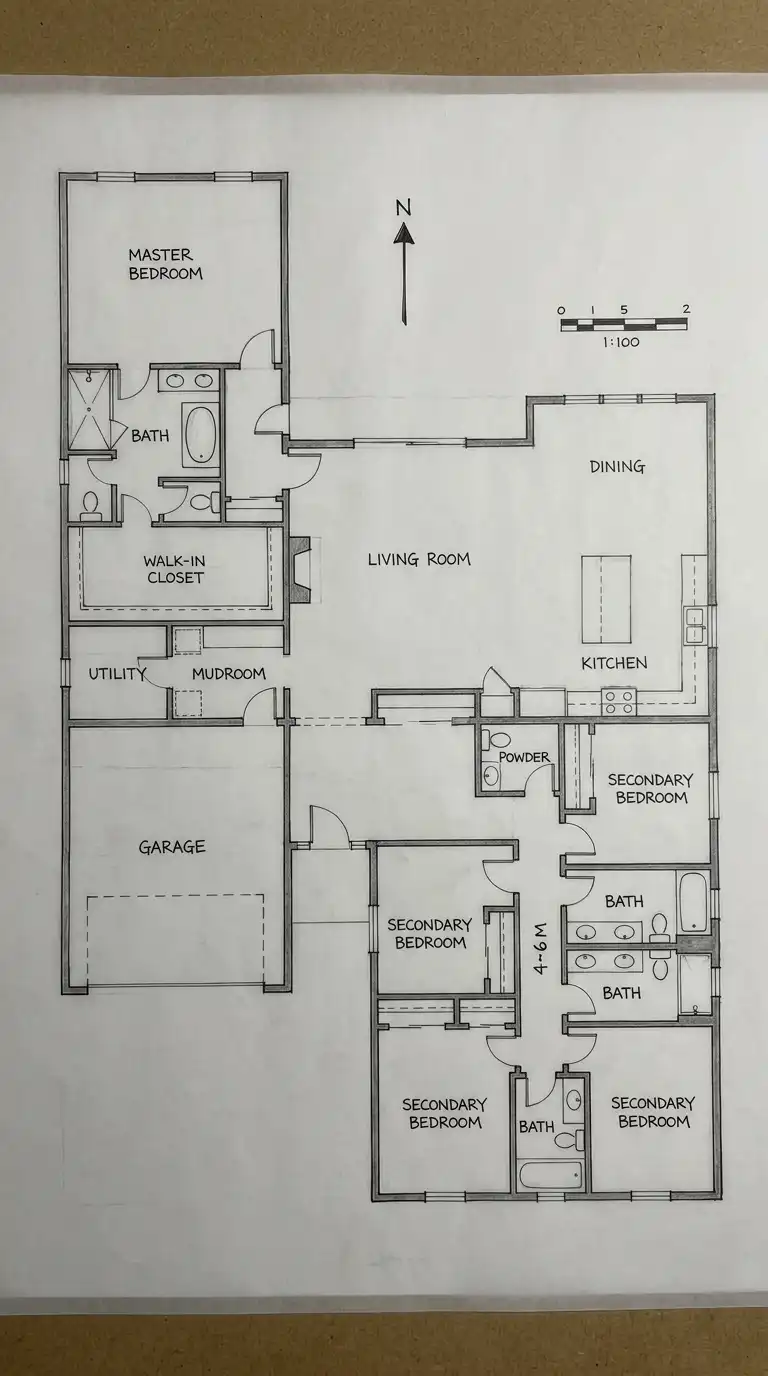
A single-story plan where the master bedroom is isolated on one side of the house, and the four secondary bedrooms are grouped on the opposite side. The living, dining, and kitchen occupy the center. The master suite has privacy and quiet away from children’s bedrooms or guest rooms. A short hallway serves the secondary bedrooms; the master has a direct door from the living area. This is the most popular 5-bedroom plan for families with children.
This plan is for large families, multigenerational households, or any client who wants the master bedroom separated from the secondary bedrooms. The emotional effect is split, private, and hierarchical.
Quick Specs
- Total area: 220-300 m² (2,400-3,200 sq ft).
- Master suite: 25-35 m² with attached bathroom (double vanity, shower, tub, private toilet) and walk-in closet (6-10 m²).
- Secondary bedrooms: 12-18 m² each (four bedrooms).
- Living-dining-kitchen: 55-75 m² (open plan).
- Common bathrooms: 2 (one for two secondary bedrooms, or one for three and one for one).
- Powder room: 3-5 m² off the living area.
- Utility room: 6-10 m² near the kitchen.
2. The Two-Story Plan (Master Up or Down, Secondary Up)
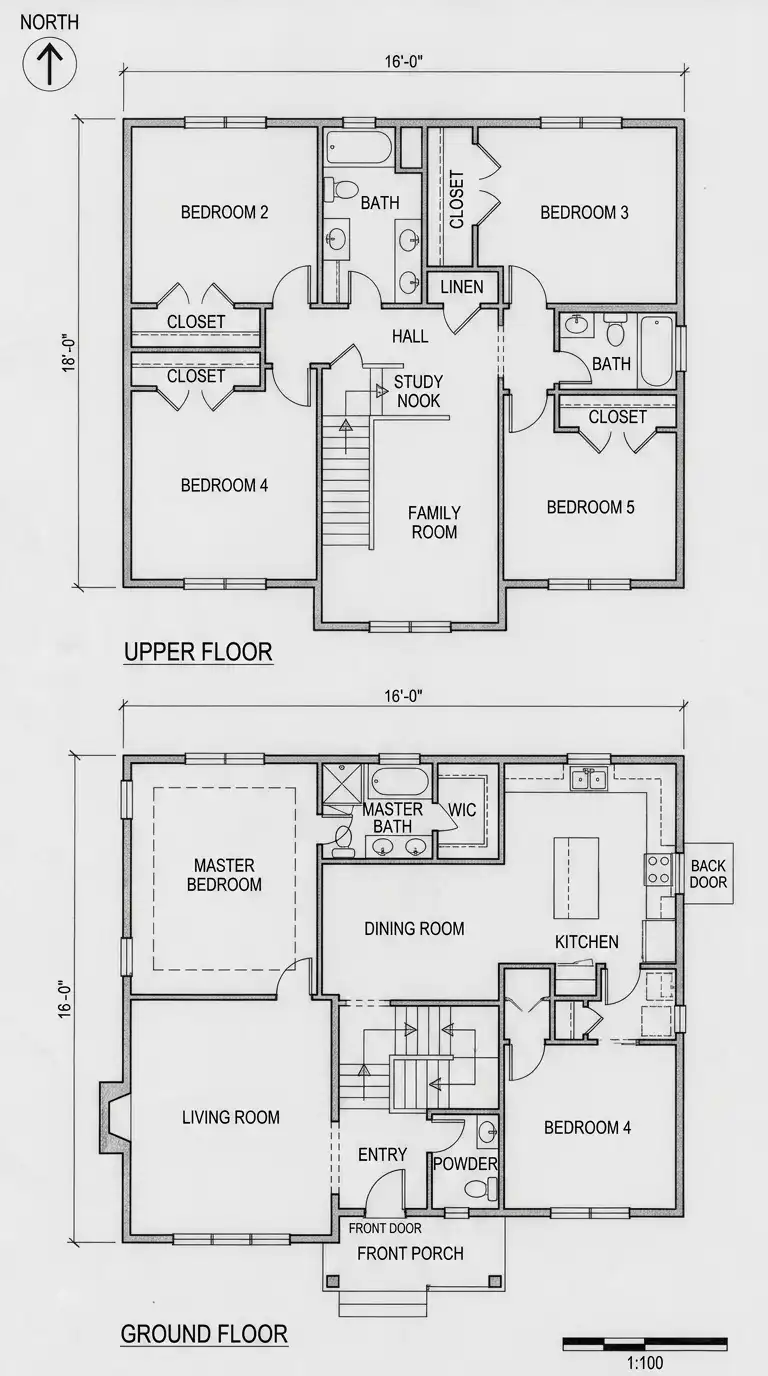
A two-story house with five bedrooms. In the most common configuration for families, the master bedroom is on the ground floor (for privacy and aging in place), and the four secondary bedrooms are on the upper floor (for children or guests). Alternatively, all five bedrooms can be on the upper floor, with the ground floor dedicated entirely to living spaces. The two-story plan is efficient on narrow lots and separates public (ground) from private (upper).
This plan is for narrow lots, families with children, or any client who wants a smaller footprint. The emotional effect is vertical, private-up-public-down, and efficient.
Quick Specs
- Ground floor area: 100-140 m² (1,100-1,500 sq ft).
- Upper floor area: 90-130 m² (1,000-1,400 sq ft).
- Master bedroom (ground floor): 25-35 m² with attached bathroom and walk-in closet.
- Secondary bedrooms (upper floor): 12-18 m² each (four bedrooms).
- Stair width: 1.0-1.2 m.
- Common bathrooms on upper floor: 2 (one for two bedrooms each).
- Powder room on ground floor: 3-5 m².
3. The Multigenerational Plan (Two Master Suites + Three Bedrooms)
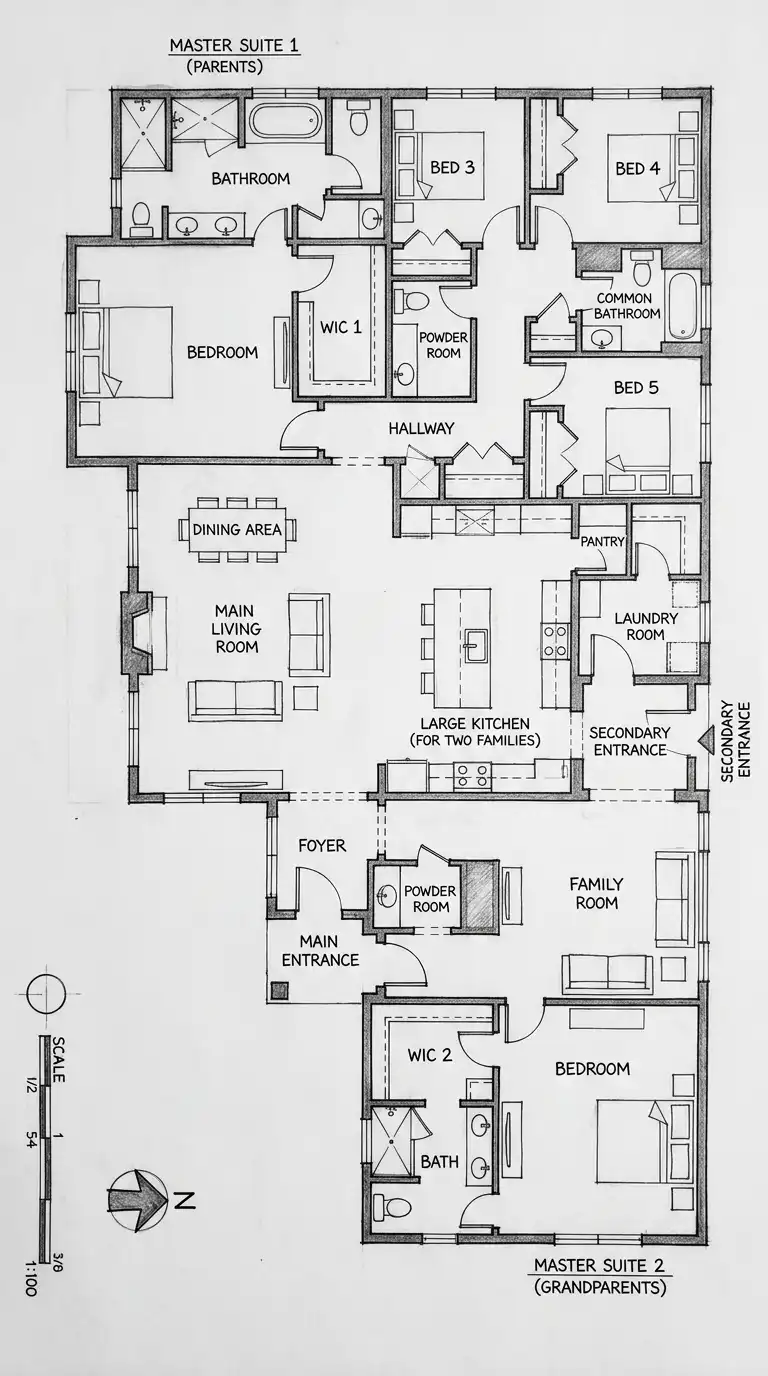
A plan designed for two generations living together (aging parents and adult children, or two families sharing one house). The plan has two master suites (one on each side of the house or on different floors), each with its own attached bathroom and walk-in closet. The three secondary bedrooms are grouped together. The living, dining, and kitchen are shared. The plan may have two separate entrances and two separate living areas (a main living room and a family room). This plan provides privacy for both generations while keeping them connected.
This plan is for multigenerational households, families with aging parents, or two families sharing a house. The emotional effect is dual-master, private, and flexible.
Quick Specs
- Total area: 250-350 m² (2,700-3,800 sq ft).
- Master suite 1 (parents): 25-35 m² with attached bathroom and walk-in closet.
- Master suite 2 (grandparents or adult children): 20-30 m² with attached bathroom and walk-in closet.
- Secondary bedrooms: 12-18 m² each (three bedrooms).
- Living areas: main living room (30-40 m²) and family room (20-30 m²).
- Kitchen: large (20-30 m²) for two families.
- Common bathrooms for secondary bedrooms: 1-2.
4. The Courtyard Plan (Five Bedrooms Around a Central Court)
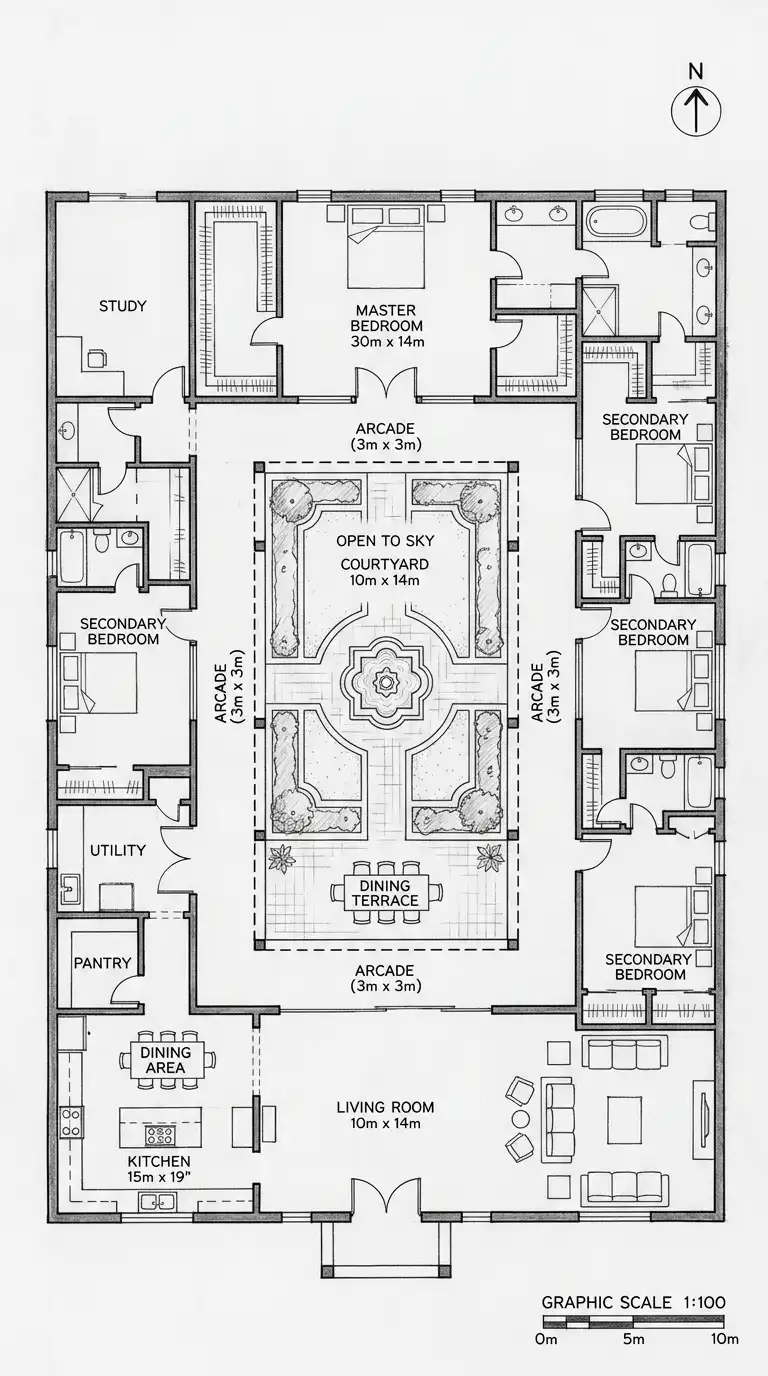
A single-story house organized around a central open-to-sky courtyard. The five bedrooms and the living spaces surround the courtyard on four sides. The courtyard provides light, ventilation, and a private outdoor space. The exterior walls have few or no windows—the house turns inward for privacy and climate control. This plan is ideal for hot climates, dense urban areas, or any site requiring privacy from neighbors.
This plan is for houses in hot climates, on large urban lots, or for clients who value extreme privacy. The emotional effect is inward, courtyard-centered, and climate-responsive.
Quick Specs
- Total area: 250-400 m² (2,700-4,300 sq ft).
- Courtyard size: 8m x 10m to 12m x 15m.
- Room depth: 5-7 m (rooms open to courtyard).
- Exterior walls: few or no windows (solid lines).
- Arcade: covered walkway (2.5-3.5m wide) around the courtyard.
- Courtyard access: doors or large windows from every room.
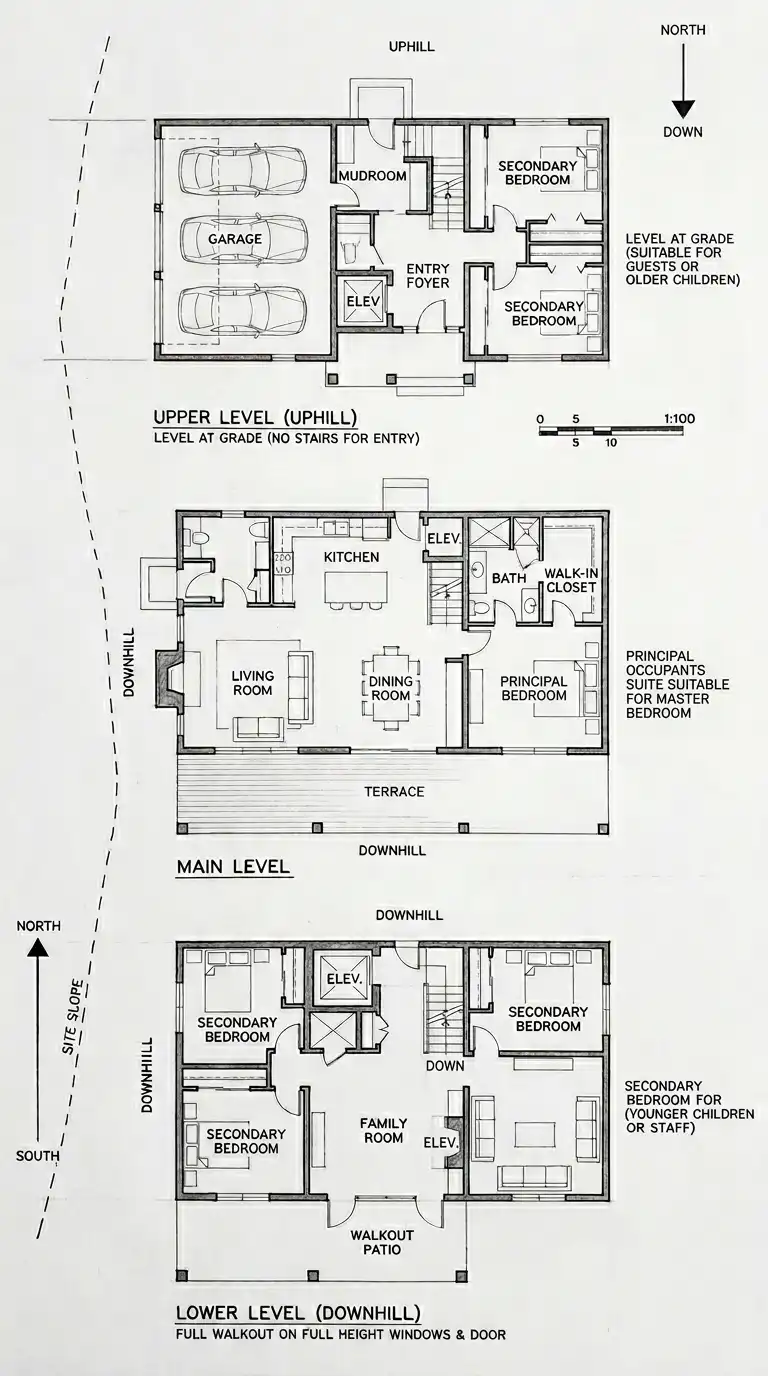
5. The Hillside Plan (Stepped, View-Oriented, Walkout)
A house on a sloping site, with the plan stepped to follow the topography. The five bedrooms are distributed across multiple levels. The entrance is on the uphill side (upper level). The living spaces are on the middle level (with the best view). Bedrooms are on the upper and lower levels. The house has multiple levels connected by stairs or an elevator. The downhill side has walkout basements and terraces. The view is the primary organizing principle—all main rooms face downhill.
This plan is for hillside sites, coastal bluffs, or any site with a significant view. The emotional effect is stepped, view-oriented, and topographically responsive.
Quick Specs
- Slope: 15-40%.
- Levels: 3-4 (stepped with the slope).
- View direction: downhill (often west or south).
- Master bedroom: on the view level (middle or lower).
- Secondary bedrooms: on upper and lower levels.
- Elevator: recommended for 3+ levels.
Comparison Summary
| Plan Type | Primary Feature | Best For | Master Privacy | Footprint | Stairs |
|---|---|---|---|---|---|
| Split-Bedroom | Master separate from four secondary | Large families, privacy | Very high (opposite side) | Wide (plain-pied) | None |
| Two-Story | Master on ground, secondary up | Narrow lots, families with children | High (different floor) | Narrow | One stair |
| Multigenerational | Two master suites + three secondary | Two generations living together | Very high (opposite sides) | Wide or two-story | None or one |
| Courtyard | Five bedrooms around central court | Hot climates, extreme privacy | High (different sides) | Square (plain-pied) | None |
| Hillside | Stepped, view-oriented | Sloping sites with views | High (level separation) | Stepped | One stair + elevator |
Conclusion
The 5-bedroom house floor plan is designed for large families, multigenerational households, or homeowners who need a dedicated guest suite, home office, and staff quarters in addition to family bedrooms. The challenge is not adding a fifth bedroom—it is arranging five bedrooms and the living spaces in a way that balances privacy, efficiency, light, circulation, and flexibility for changing family needs over time.
The five plans presented here offer different strategies:
The Split-Bedroom Plan separates the master bedroom from the four secondary bedrooms by placing them on opposite sides of the living area. This is ideal for families with children of different ages: parents have quiet; children have their own zone. The plan requires a wide lot (at least 15-18m) because the house spreads horizontally.
The Two-Story Plan places the master bedroom on the ground floor and the four secondary bedrooms on the upper floor. This is ideal for narrow lots (8-12m wide) or for clients who want the master on the ground floor for aging in place while children are upstairs. The stairs are the only drawback (not accessible for everyone, and parents may not want to climb stairs to check on children).
The Multigenerational Plan has two master suites (one for parents, one for grandparents or adult children) and three secondary bedrooms. This is ideal for two generations living together. The plan provides privacy for both generations while keeping them connected through shared living, dining, and kitchen spaces. The plan requires a wide lot or two stories.
The Courtyard Plan wraps the five bedrooms around a central open-to-sky courtyard. This is ideal for hot climates or dense urban areas where exterior windows are undesirable (privacy, heat gain, security). Every bedroom gets light and ventilation from the courtyard. The plan requires a square or nearly square lot.
The Hillside Plan distributes the five bedrooms across multiple levels on a sloping site. The master bedroom is on the view level (often the middle level). Secondary bedrooms are on the upper and lower levels. This is ideal for sites with a significant view. The plan requires an elevator for accessibility and careful grading to balance cut and fill.
When designing a 5-bedroom house floor plan, consider:
Master privacy. Where is the master bedroom relative to the secondary bedrooms? Split-bedroom and multigenerational plans offer the most privacy (opposite sides of the house). Two-story plans offer vertical separation. Courtyard plans offer separation by different sides of the courtyard.
Number of bathrooms. A 5-bedroom house typically has 3.5 or 4 bathrooms: an attached bathroom for the master, one or two common bathrooms for the four secondary bedrooms (often one bathroom per two bedrooms), and a powder room for guests on the ground floor. Some luxury plans have an attached bathroom for every bedroom.
Closet space. Each bedroom should have a closet. The master should have a walk-in closet (minimum 2m x 3m). Secondary bedrooms can have reach-in closets (1.5-2.5m wide). A linen closet near the bathrooms and a coat closet near the entrance are essential.
Circulation. Long corridors waste space. In a 250 m² house, a 12m long, 1.2m wide corridor uses 14.4 m² of space that could be a larger bedroom or living area. Split-bedroom and courtyard plans minimize corridors. Two-story plans have a landing at the top of the stairs but not necessarily long corridors.
The living-dining-kitchen. In a 5-bedroom house, the living area should be at least 55-75 m² (combined) to comfortably accommodate a family of five to seven people. Open plans are common because they make the space feel larger and allow the cook to interact with the family.
Flexibility for changing needs. A 5-bedroom house may be used differently over time: young children (all five bedrooms as children’s rooms), teenagers (one bedroom becomes a study lounge), empty nesters (two bedrooms become a home office and a gym), or multigenerational (two master suites). The plan should allow bedrooms to be repurposed without major renovation.
The best 5-bedroom plan is not the one with the most square meters. It is the one where the parents can have a quiet conversation in the master bedroom while teenagers do homework in their rooms, where grandparents have their own suite with a private entrance, where the kitchen is visible from the living room (so the cook is not isolated), where the morning rush (five people needing bathrooms) is manageable, and where every bedroom has its own light and ventilation. It is a plan for a large family, not just for sleeping.